

AI Can Improve Technical Support. It Can’t Replace Technical Judgement
Across industries, organisations are investing heavily in AI to improve technical support. It’s an understandable shift. Support is expensive, demand is unpredictable and AI promises faster responses, greater consistency and lower operating costs. The challenge isn’t whether AI belongs in technical support. It clearly does. The real question is where AI adds the most value and where human judgement remains essential. AI excels at handling repeatable questions with predictable answers. But when support becomes diagnosis, where context, judgement and accountability matter, the picture changes. That’s especially true in solar, where growing battery complexity has raised both the technical difficulty and the cost of getting a diagnosis wrong.
Support and diagnosis are not the same thing.
Salesforce provides a useful example of what happens when organisations overestimate what AI can handle independently. The company replaced 4,000 support roles with AI agents, expecting the usual efficiency gains. Instead, the bots performed well on simple, high-volume enquiries but struggled with the issues customers actually contacted support about, including billing disputes, complex returns and cases requiring historical context or judgement beyond a scripted response. CEO Marc Benioff has since acknowledged the company is rehiring at around 1.5 times the original cost.
IKEA reached almost the opposite outcome because it applied AI to a different layer of the support function. Rather than replacing advisers handling complex customer needs, AI absorbed repetitive enquiries while 8,500 employees were reskilled into interior design advisers, doing work AI couldn’t do. The result wasn’t just lower operating costs but approximately US$1.4 billion in additional consulting revenue.
The difference wasn’t the technology itself. It was understanding which parts of support benefited from automation and which still depended on human expertise. Technical field support often falls into the second category.
Diagnosis is different.
Most technical support organisations, regardless of industry, already operate a tiered model because no single layer can handle every type of issue.
L1 (first-line support) manages high-volume, pattern-based enquiries such as order status, basic setup questions and known-issue triage. These are exactly the types of interactions where AI can create significant value by giving human agents faster access to information, automating administrative tasks and helping resolve routine enquiries more efficiently. AI makes first-line support faster and more consistent, but it doesn’t eliminate the need for people. Even a straightforward enquiry can quickly become something that requires judgement, and a human on the call is often what recognises that shift.
L2 (technical escalation) is different. The same fault code can have several possible causes depending on the installation environment, equipment age, firmware version and what happened before the failure. Diagnosing it requires someone who can hold context across an entire case, weigh competing explanations and make a technical judgement based on experience rather than pattern matching.
L3 (deep engineering) deals with genuinely novel issues requiring product or engineering expertise.
The mistake many organisations make is assuming that because most tickets appear straightforward, the entire support function is simple. It isn’t. A fault code on a live installation, with an installer or homeowner waiting for an answer, isn’t a lookup-table exercise. It’s a diagnostic problem and diagnosis remains an area where human judgement consistently outperforms AI.
Batteries make technical judgement even more important.
Solar illustrates this challenge particularly well because of how rapidly battery storage has evolved. Only a few years ago, supporting a residential solar system meant understanding panels, an inverter and a relatively stable set of failure modes. Today’s installations are considerably more sophisticated. Different battery chemistries behave differently, battery management systems interact with inverters from multiple OEMs, firmware updates can change system behaviour overnight and warranty decisions often carry significant operational and safety consequences.
As systems become more complex, diagnosing faults becomes more complex too. A fault code that indicates one issue on one battery platform may indicate a different underlying cause on another. Determining whether a system requires a remote reset, an on-site inspection or immediate isolation isn’t simply following a decision tree. It requires technical judgement informed by the specific equipment, installation history, operating conditions and the sequence of events that led to the fault. The challenge is compounded by how quickly the technology continues to evolve. New battery platforms, firmware releases and integration methods are constantly entering the market, meaning technical expertise must evolve alongside them.
This is exactly where AI has an important role to play.
Routine enquiries, commissioning guidance and well-understood fault patterns are well suited to automation. AI can surface relevant documentation, identify known issues, reduce administrative workload and help first-line support teams respond faster and more consistently.
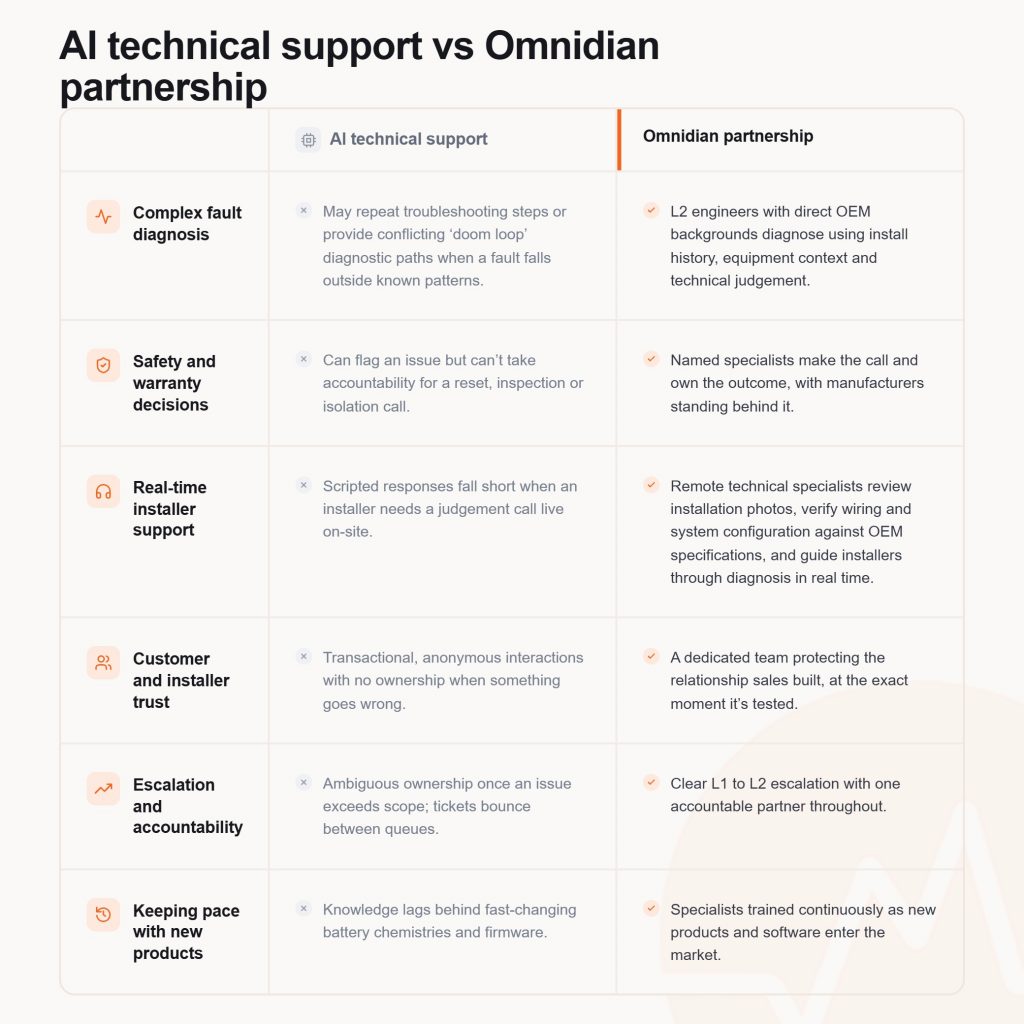
What AI cannot do reliably is assume accountability when a diagnosis falls outside known patterns.
When a battery fault carries safety implications, warranty exposure and multiple plausible causes, the question is no longer ‘What does the manual say?’ It’s ‘What is most likely happening on this specific system?’ That distinction matters. The value of AI isn’t replacing technical judgement. It’s giving technical specialists better information so they can make better decisions, faster. As battery systems continue to become more capable and interconnected, that combination of automation and human expertise becomes increasingly important.
Getting the diagnosis wrong has real consequences.
The difference between answering a question and diagnosing a fault matter because of what’s at stake. A stalled installation or unresolved fault doesn’t simply delay a project. It’s often the moment trust between the installer, homeowner and manufacturer is either strengthened or damaged.
When an experienced specialist takes ownership, correctly diagnoses the issue and resolves it efficiently, confidence grows across the entire relationship. When responsibility becomes fragmented across chatbots, ticket queues and unclear escalation paths, the damage rarely stays confined to the support function. Installers and homeowners don’t separate product quality from support quality. To them, it’s one experience.
Battery systems raise those stakes even further. An unresolved or misdiagnosed fault isn’t only a customer service issue. It can become a safety issue, with implications for the installer, homeowner and manufacturer alike. That’s why the strongest support organisations aren’t asking whether AI should replace people. They’re asking how AI can make experienced technical teams more effective.
AI improves support. Technical judgement resolves complexity.
AI has a significant role to play in the future of technical support, but its greatest value lies in making experienced teams faster, more consistent and better informed. Routine enquiries, known fault patterns and repeatable processes are well suited to automation. Complex diagnosis requires context, accountability and the ability to make informed decisions when the answer isn’t immediately obvious. The manufacturers that will be best positioned for the future are those that understand the difference.
What a well-designed support model looks like.
If AI is most effective at handling routine enquiries while experienced specialists remain essential for complex diagnosis, the strongest support models combine both rather than treating them as competing approaches. Omnidian’s service model follows that principle. An onshore L1 team manages customer enquiries, known fault patterns and initial triage, supported by AI that improves speed, consistency and access to information. When an issue requires deeper technical investigation, it escalates to L2 remote technical specialists who support installers from commissioning through to the operational life of the system.
These L2 specialists are experienced service engineers, many with backgrounds working directly for OEMs across the industry. That expertise is increasingly important because today’s faults rarely involve a single component. A diagnosis may require understanding how a battery, inverter and battery management system interact across multiple manufacturers, firmware versions and installation environments.
A shared service platform provides manufacturers, installers and support teams with complete visibility of ticket progress, case history and technical decisions from a single source of truth. Within that model, AI improves efficiency and consistency, while experienced specialists remain responsible for the technical judgement required to diagnose complex issues and determine the most appropriate course of action.
Sales builds the relationship. Service protects it.
Manufacturers already invest heavily in relationship-building through sales: understanding an installer’s business, backing them at the point of purchase, being there when a contract is signed. That investment pays off, right up until something goes wrong on-site.
The moment an installer or homeowner hits a fault they can’t resolve is the moment that relationship gets tested. It’s no longer a sales conversation, it’s a trust conversation and trust built over months in the sales process can be undone in one unresolved support call. If a chatbot is the only thing standing between a breach of trust and a moment of repair, the company has handed its highest-stakes moment to the function least equipped to handle it.
This is the part cost models tend to miss. Service and support aren’t a downstream cost centre, separate from the relationship sales built. They’re where that relationship is defended, or lost, every time something breaks.
Technical support is becoming a competitive advantage.
The question is no longer whether AI has a place in technical support. Its ability to improve response times, streamline repetitive tasks and provide faster access to information makes it an increasingly valuable part of modern support operations.
The greater challenge for manufacturers is understanding where automation delivers the greatest value and where technical judgement continues to make the greatest difference. As battery systems become more sophisticated, diagnosing faults increasingly requires context, experience and accountability rather than simply identifying known patterns.
Manufacturers that combine AI with experienced technical specialists will be better positioned to deliver both operational efficiency and high-quality customer outcomes. AI can improve the speed and consistency of technical support, but trust continues to be built through accurate diagnosis, clear ownership and confident decision-making. As solar systems continue to evolve and battery adoption accelerates, technical support is becoming more than an operational function. It is becoming an important point of differentiation for manufacturers seeking to strengthen installer relationships and build long-term confidence in their products.
Let’s Talk